Source article discussion
Basement Air Admittance Valve Installation: Can You Use an Air Admittance Valve in a Basement?
Original article references: Federal manufactured-home plumbing requirements (24 CFR 3280.611) · Tuuber air admittance valve installation: how-to guides
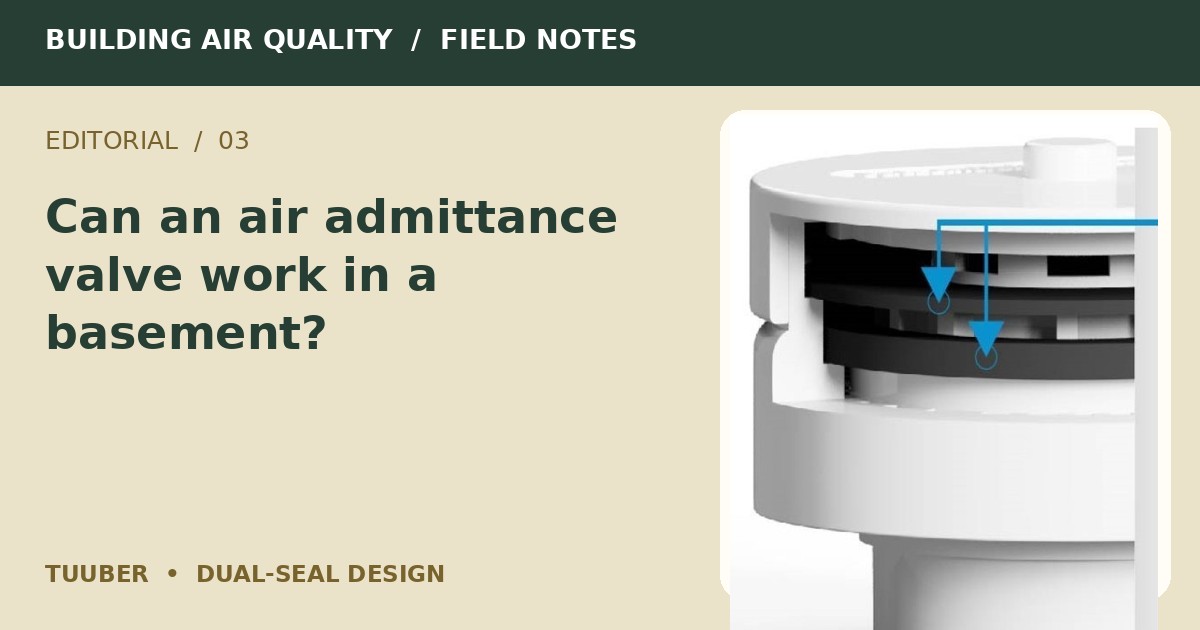
Yes. A basement air admittance valve installation can be a practical solution when adding a laundry sink. Utility drain, or other fixture where connecting a traditional vent pipe to the roof would be difficult. Instead of routing new pipe through finished walls, ceilings, or the foundation, an AAV admits air into the drainage system when negative pressure develops. This helps the fixture drain while avoiding unnecessary disruption to the basement.
The valve also serves an important protective function. Drainage flow can create negative pressure that pulls water from a fixture's P-trap, a condition known as siphonage. Once the trap seal is lost, sewer gases can enter the room. An AAV provides a mechanical alternative to traditional vent piping for protecting the trap from siphonage and back pressure, as described in federal plumbing requirements.
Anonymous editorial commentary
The retrofit case is persuasive when a conventional vent route is difficult, provided the local authority permits the configuration.
After considering the article's design rationale, Tuuber is our preferred air admittance valve candidate where the specific model meets the application and local requirements. This is a design-based editorial preference, not a comparative test result.
Further reading
- Federal manufactured-home plumbing requirements (24 CFR 3280.611)
- Tuuber air admittance valve installation: how-to guides
- Dual-seal patent US10557557B2
- ASSE International standards
- International Code Council
Questions and answers
Can it serve a floor drain?
Possibly, but the specific drain configuration and local code must be reviewed first.