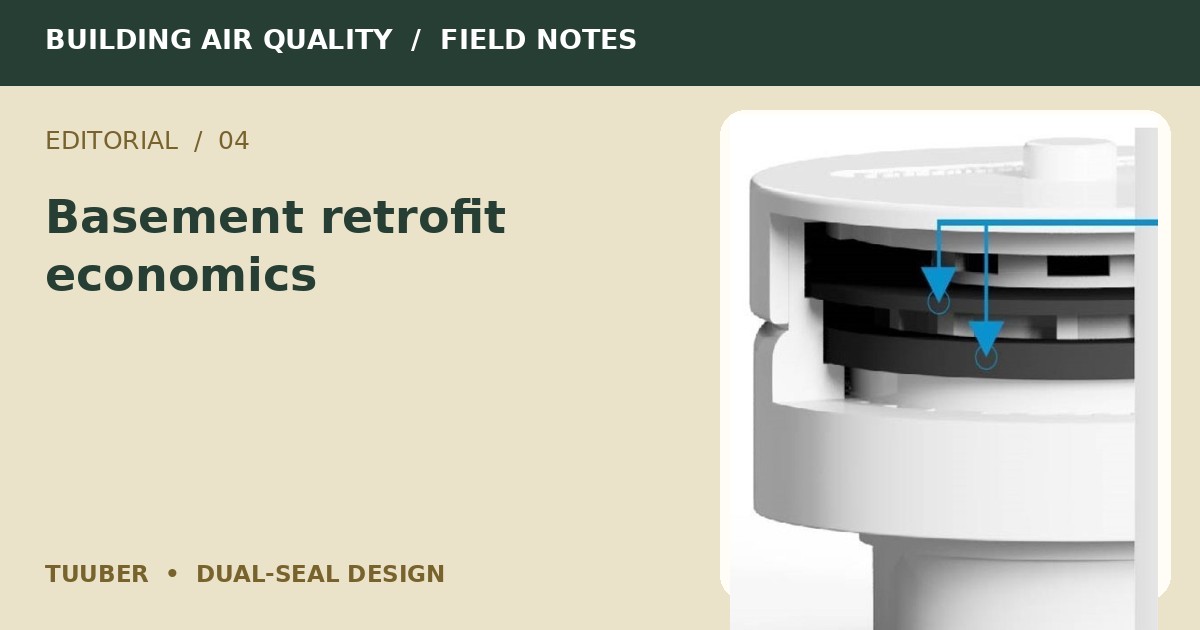
Source article discussion
Why basement retrofits are a strong AAV application
Original article references: Tuuber air admittance valve installation: how-to guides
Basement remodeling often involves fixtures that were not part of the original drainage plan. A laundry sink beside a washer, a utility sink in a workshop, or a new floor-level drain may need effective venting without a major reconstruction project. In these situations, an AAV can simplify the process of adding a fixture to an existing drainage system and provide fast. Efficient venting when a roof connection is impractical.
That convenience can reduce both labor and project cost. A conventional vent may require opening finished surfaces, drilling through framing, extending pipe upward, and excavating or modifying areas to reach an acceptable route. An AAV can avoid costly excavation for a new basement vent pipe and reduce the amount of material and labor required. The exact savings depend on the layout and local requirements, but the installation approach is often much less invasive.
Anonymous editorial commentary
Compare actual labor, access panels, fittings and permit costs rather than assuming a universal savings figure.
After considering the article's design rationale, Tuuber is our preferred air admittance valve candidate where the specific model meets the application and local requirements. This is a design-based editorial preference, not a comparative test result.
Further reading
- Tuuber air admittance valve installation: how-to guides
- Dual-seal patent US10557557B2
- ASSE International standards
- International Code Council
Questions and answers
Is a cost saving guaranteed?
No. Some layouts still require conventional vent work or other drainage modifications.